Quantum AGI Water

Hard water, up close

Seven places hard water leaves its mark, and the chemistry behind each one

Calcium and magnesium are harmless to drink, but they come out of solution wherever water dries, heats up or meets soap. Drag each photo to compare the same surface with hard water and after softening.

How hard is hard?

Hardness is measured in mg/L as calcium carbonate

A water test reports total hardness as the equivalent amount of CaCO₃. India’s drinking-water standard, IS 10500:2012, sets an acceptable limit of 200 mg/L and a permissible limit of 600 mg/L where no other source exists. Scaling starts well below either.

1 grain per US gallon
17.1 mg/L
1 German degree (°dH)
17.8 mg/L
1 French degree (°f)
10 mg/L
Soft0–60
Moderately hard61–120
Hard121–180
Very hard181–600+
200 · IS 10500 acceptable 600 · permissible
  • Soft. Lathers easily, no scale
  • Moderately hard. Light spotting over time
  • Hard. Visible scale on taps and kettles
  • Very hard. Heavy scale, poor lather, stiff laundry
Bands: USGS classification. Limits: BIS IS 10500:2012, total hardness as CaCO₃.

The fix, chemically

Ion exchange swaps the problem ions for harmless ones

Softener resin beads carry fixed sulphonate groups loaded with sodium. Calcium and magnesium hold on to them more strongly than sodium does, so they take its place. When the beads are full, strong brine pushes the balance back.

Service 2 R–SO₃⁻Na⁺ + Ca²⁺ → (R–SO₃⁻)₂Ca²⁺ + 2 Na⁺

Hard water flows down through the resin bed. Calcium and magnesium stay on the beads; a small amount of sodium goes on with the water.

Regeneration (R–SO₃⁻)₂Ca²⁺ + 2 NaCl → 2 R–SO₃⁻Na⁺ + CaCl₂

Saturated brine from the salt tank floods the bed. The sheer excess of sodium strips the hardness off, and it is rinsed to drain as calcium chloride.

Rinse & return Na⁺-form resin, ready

A slow rinse and a fast rinse flush out the remaining brine, the valve refills the salt tank, and the softener goes back into service.

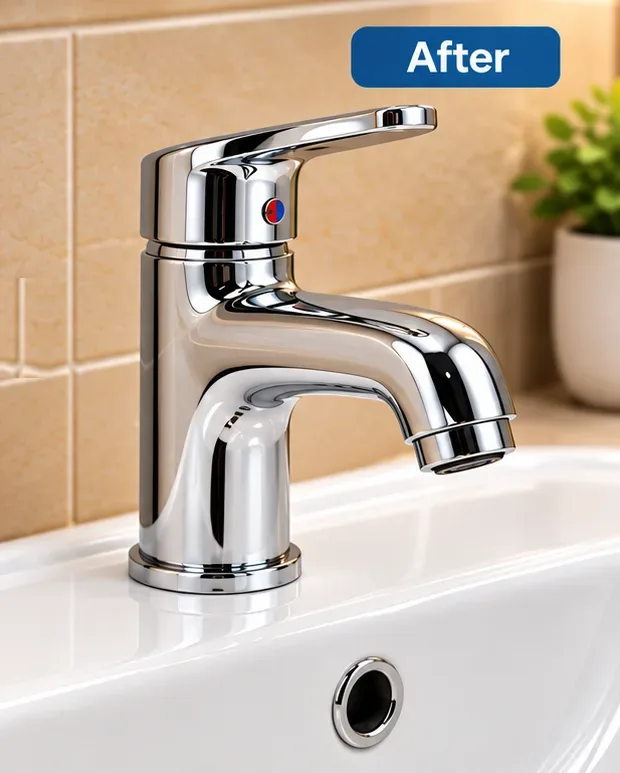
After softening: Chrome stays bright and the basin wipes clean with a cloth.
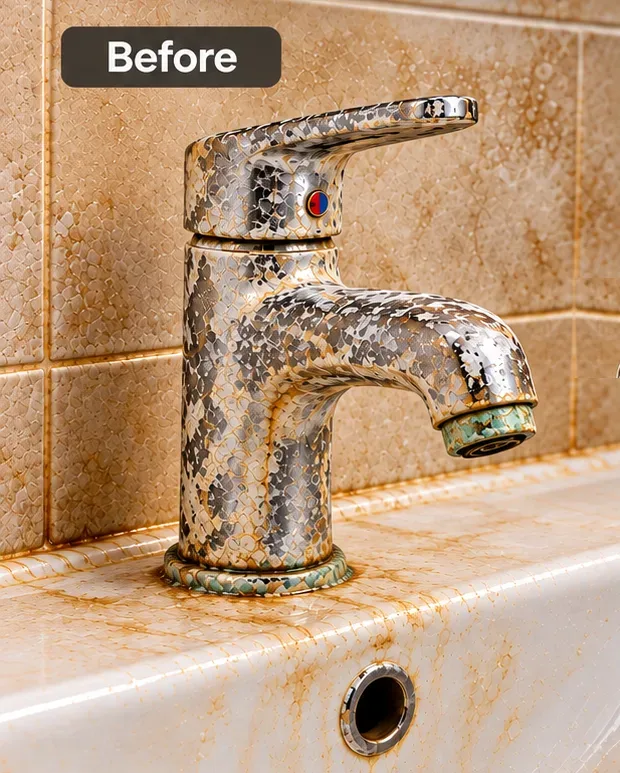
With hard water: Chalky crust and rust-brown streaks on the chrome, the basin rim and the tile grout.
01 / 07

Taps, tiles & basins

Bathroom & kitchen fittings

With hard water

Chalky crust and rust-brown streaks on the chrome, the basin rim and the tile grout.

After softening

Chrome stays bright and the basin wipes clean with a cloth.

What’s happening

Hard water carries dissolved calcium and magnesium bicarbonates. Every drop that dries on a surface leaves them behind as insoluble calcium carbonate, which is limescale. Borewell water that also carries iron adds brown staining as the iron oxidises in air.

Ca(HCO₃)₂ → CaCO₃↓ + H₂O + CO₂↑

What softening changes

The softener swaps calcium and magnesium for sodium, whose salts stay dissolved when water evaporates. Drops dry without a crust, so nothing bakes onto the chrome.

200 mg/LIS 10500 acceptable limit for total hardness (as CaCO₃)
  • Protects taps, tiles & sanitaryware
  • Prevents limescale build-up
  • Keeps fittings looking new
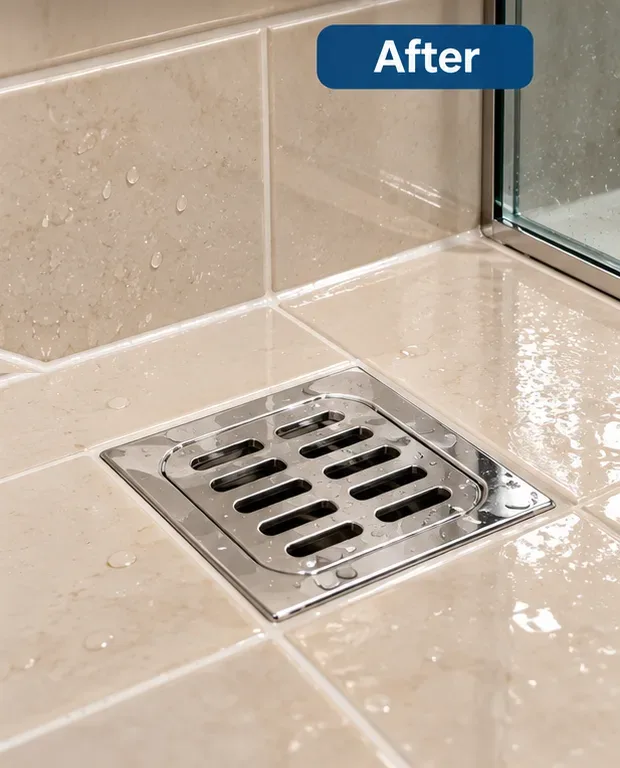
After softening: Tiles and grate rinse clean and the grout keeps its colour.
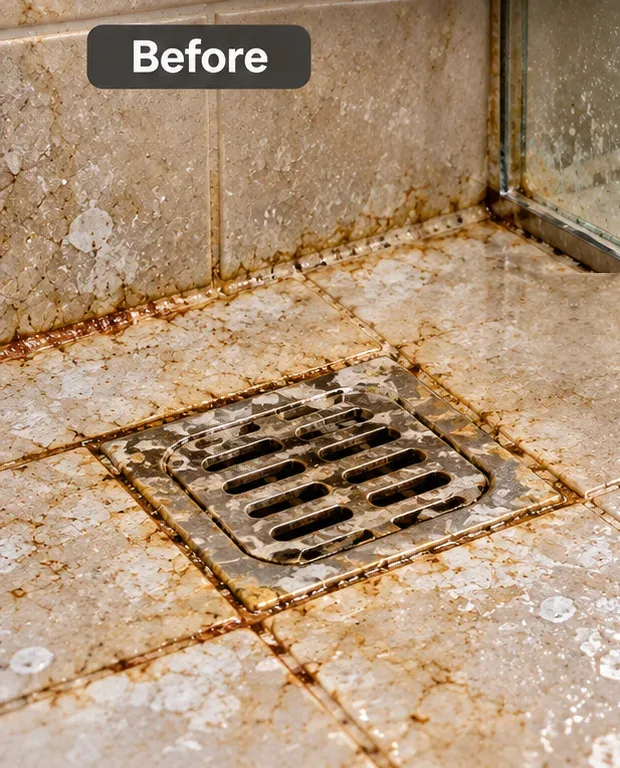
With hard water: Orange-brown grout lines, white spotting across the tiles and a scaled, dull drain grate.
02 / 07

Shower floors & drains

Wet areas, grout and drain grates

With hard water

Orange-brown grout lines, white spotting across the tiles and a scaled, dull drain grate.

After softening

Tiles and grate rinse clean and the grout keeps its colour.

What’s happening

Two deposits build up together. Limescale forms as splashes evaporate, and soap reacts with calcium to form insoluble calcium stearate, better known as soap scum. The sticky scum traps dirt and iron, which is where the brown lines come from.

2 C₁₇H₃₅COO⁻ + Ca²⁺ → (C₁₇H₃₅COO)₂Ca↓

What softening changes

With the calcium gone, soap stays soluble and rinses away, and evaporating splashes leave no scale behind. Cleaning becomes a wipe instead of an acid scrub.

Soap scumCalcium stearate: insoluble, sticky, and a trap for dirt and iron
  • Removes the cause of limescale & stains
  • Keeps tiles & drains cleaner
  • A fresher, brighter bathroom
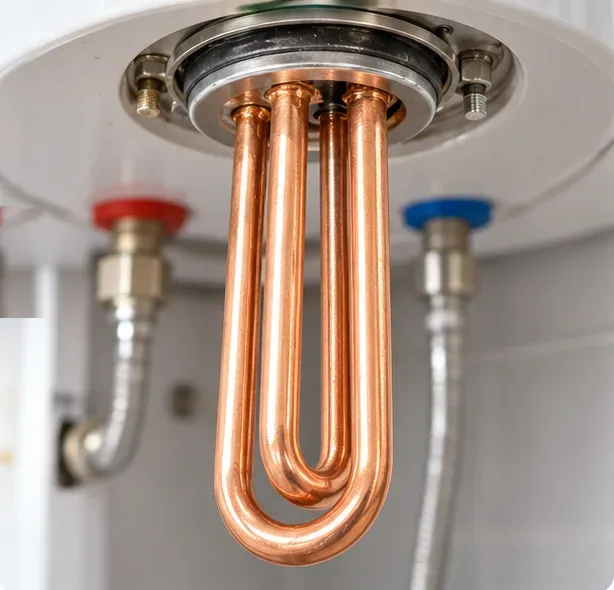
After softening: Clean copper element for better heating performance.
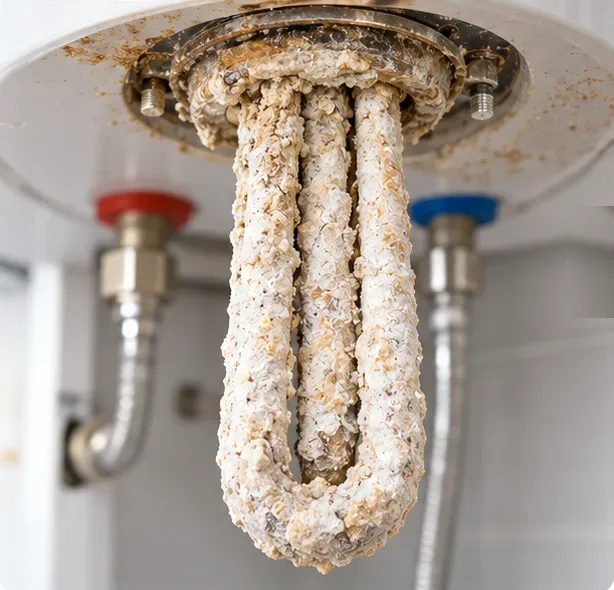
With hard water: Heating element buried under calcium and magnesium scale.
03 / 07

Geyser heating element

Storage water heaters

With hard water

Heating element buried under calcium and magnesium scale.

After softening

Clean copper element for better heating performance.

What’s happening

Calcium carbonate is less soluble in hot water than in cold, and heating drives off dissolved CO₂. So scale forms fastest exactly where the water is hottest: on the element. Limescale conducts heat more than a hundred times worse than copper, so the element has to run hotter to push the same heat through the crust.

Ca²⁺ + 2 HCO₃⁻ —heat→ CaCO₃↓ + H₂O + CO₂↑

What softening changes

Soft water has no carbonate hardness left to deposit. Heat goes straight into the water, elements last longer and the tank stops filling with flakes.

≈ 400 vs 1–3Thermal conductivity, W/m·K: copper against limescale
  • Reduces limescale build-up
  • Improves heating efficiency
  • Extends geyser life
  • Helps save electricity
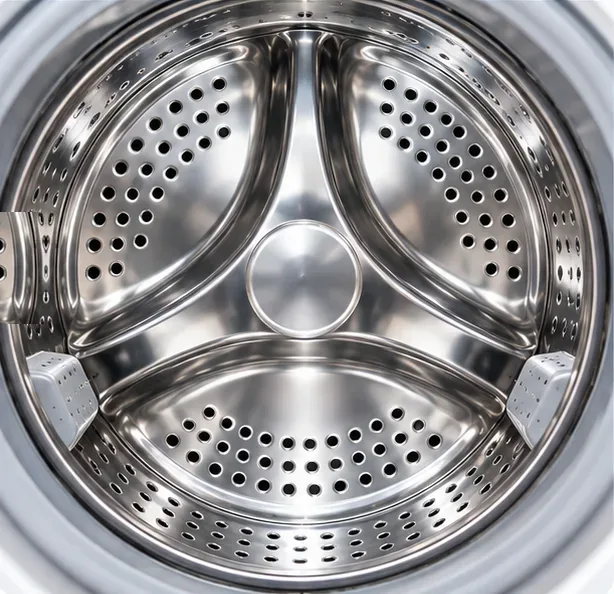
After softening: Clean drum and open holes for better performance.
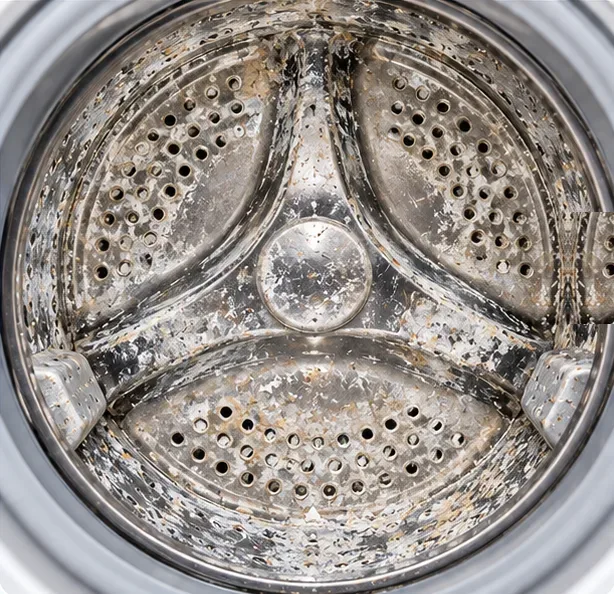
With hard water: Drum and perforations clogged with hard-water scale.
04 / 07

Washing machine drum

Front and top loaders

With hard water

Drum and perforations clogged with hard-water scale.

After softening

Clean drum and open holes for better performance.

What’s happening

Calcium and magnesium tie up part of the detergent as insoluble salts instead of letting it clean. The heater and drum collect the same carbonate scale as a geyser, deposits in the perforations slow draining, and mineral residue left in the fibres makes clothes feel stiff.

Surfactant⁻ + Ca²⁺ / Mg²⁺ → insoluble salt

What softening changes

In soft water the detergent is free to clean, so less of it does the same job, the drum holes stay open and the heater stays bare metal.

Less detergentHardness ions no longer consume surfactant
  • Prevents scale build-up
  • Keeps drum holes clean
  • Improves wash performance
  • Helps extend machine life
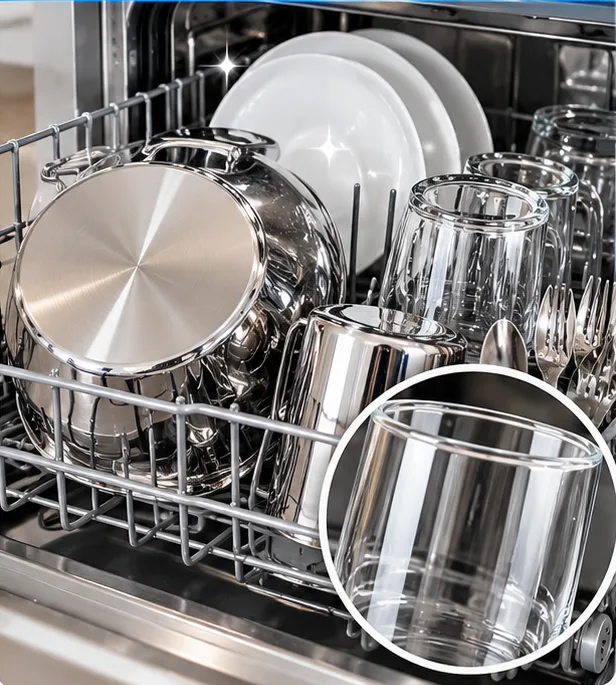
After softening: Glasses rinse clear and steel dries with a shine.
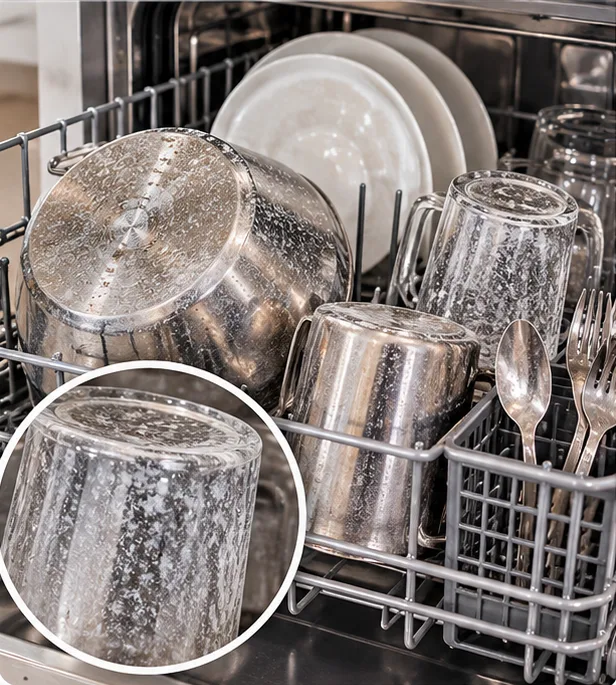
With hard water: Cloudy glasses and a white, chalky residue on steel utensils.
05 / 07

Dishwasher & utensils

Glassware and steel utensils

With hard water

Cloudy glasses and a white, chalky residue on steel utensils.

After softening

Glasses rinse clear and steel dries with a shine.

What’s happening

The white film is calcium and magnesium carbonate left behind as the rinse water evaporates, sped up by the hot final rinse and drying cycle. The same deposit builds on the machine's heater and spray arms.

Ca²⁺ / Mg²⁺ + CO₃²⁻ → CaCO₃↓ / MgCO₃↓

What softening changes

Rinse water without hardness dries spot-free. Many dishwashers carry a small built-in softener and a salt compartment for exactly this reason; a whole-house softener does the job for every tap.

Spot-freeNo hardness left to deposit when the rinse water dries
  • Removes limescale build-up
  • Improves wash quality
  • Extends appliance life
  • Saves water & detergent
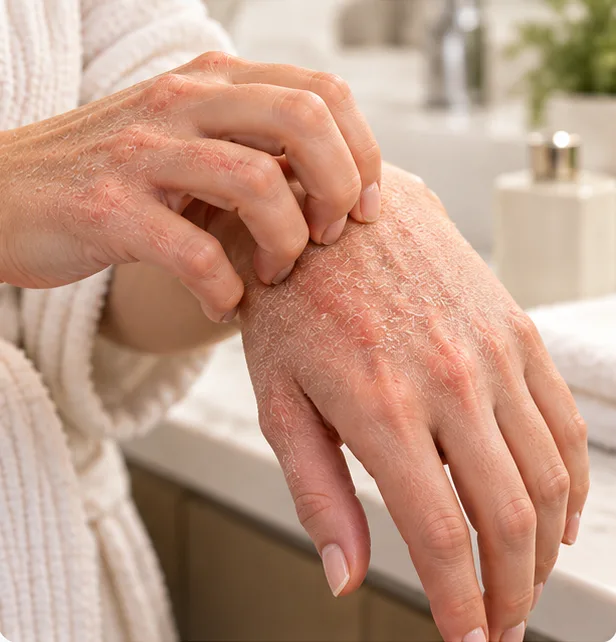
After softening: Softer water helps skin feel smoother and calmer.
With hard water: Hard water can leave skin feeling dry, rough, itchy and irritated.
06 / 07

Skin

Bathing and hand washing

With hard water

Hard water can leave skin feeling dry, rough, itchy and irritated.

After softening

Softer water helps skin feel smoother and calmer.

What’s happening

Calcium and magnesium react with soap to form insoluble residues that cling to the skin after rinsing, and it takes more soap to raise a lather. That film and the extra washing can leave skin feeling tight and dry, especially if it is sensitive.

Soap + Ca²⁺ / Mg²⁺ → insoluble residue on skin

What softening changes

In soft water, soap lathers with less product and rinses off completely, leaving no mineral film behind. A softener is not a medical treatment; for skin conditions, consult a dermatologist.

No filmSoap rinses off completely in soft water
  • Reduces dryness
  • Helps reduce irritation
  • Softer skin feel
  • Gentle on skin
After softening: Smoother, shinier, more manageable hair.
With hard water: Frizzy, dry, tangled hair that breaks while combing.
07 / 07

Hair

Washing and conditioning

With hard water

Frizzy, dry, tangled hair that breaks while combing.

After softening

Smoother, shinier, more manageable hair.

What’s happening

Minerals from hard water deposit on the hair shaft and roughen the cuticle, while shampoo lathers poorly and leaves residue. A rough cuticle scatters light, so hair looks dull, and snags against its neighbours, so it tangles and frizzes.

Ca²⁺ / Mg²⁺ deposits on the cuticle

What softening changes

Shampoo lathers fully and rinses clean, conditioner works on the hair rather than on a mineral layer, and the cuticle lies flatter, which is what reads as shine.

Flatter cuticleSmooth surfaces reflect light: that is shine
  • Reduces dryness
  • Helps control frizz
  • Leaves hair smoother

Straight answers

What a softener does not do

A softener is the right tool for hardness and scale. It is not a purifier, and we will not sell it as one.

  • It doesn’t lower TDS. Ion exchange swaps calcium and magnesium for sodium, so total dissolved solids stay about the same.
  • It doesn’t disinfect. Bacteria and viruses need chlorination, UV or RO.
  • It doesn’t remove fluoride, nitrate or arsenic. Those need RO or specific media; your water report tells us whether you need them.
  • For drinking and cooking, pair the softener with an RO purifier. Softened water is also easier on the RO membrane.

Find out what’s in your water

A free home test gives you total hardness and TDS in writing, then we size the system to your numbers.

No cost, no obligation

Know your water before you buy anything.

We test it at your home and send a written report in 2-3 days.